Thermal protection for hair: why without it your styling ruins beauty
Hair dryers, irons, curling irons - these tools have become an integral part of the daily routine of millions of women. However, few people think that the temperature of 180-220°C, which is developed by stylers, turns hair into brittle straw in a matter of months of regular use. Thermal protection for hair is not a marketing gimmick, but a scientifically proven necessity for everyone who uses hot appliances. A properly selected product creates a protective barrier between high temperature and the keratin structure of the hair, preventing the destruction of protein bonds and moisture loss.
Thermal protection for hair: the science of salvation from high temperatures
Hair is 90% keratin, a protein that begins to denature at temperatures above 150°C. Most household appliances operate in the range of 180-230°C, which is well above the critical threshold. Without protection, each styling literally "cooks" your hair, destroying the disulfide bonds between keratin molecules. Thermal protection for hair creates a thin film of polymers and silicones that reflects some of the heat and evenly distributes the temperature over the hair surface.
Modern formulas work on multiple levels at once. They contain high-molecular silicones to create a heat-resistant barrier, hydrolyzed proteins to restore the structure from the inside, and moisturizing ingredients to retain moisture. Some professional heat protectants can withstand temperatures up to 230°C without degrading the formula. Scientific studies confirm that hair treated with a heat protectant before styling at 200°C retains 60-70% more moisture and has 40% less breakage compared to untreated hair.
Professional thermal hair protection contains additional ingredients that not only protect, but also improve the quality of styling - add shine, make straightening or curling easier, and prolong the durability of the hairstyle. This is not just a cosmetic effect - it is real physical protection of the keratin structure from thermal degradation at the molecular level.

Types of thermal protection: find your format
The market offers a variety of heat protection formats, each with its own advantages. The choice between spray, mist, or cream depends on your hair type and desired result.
Hair sprays and bridges
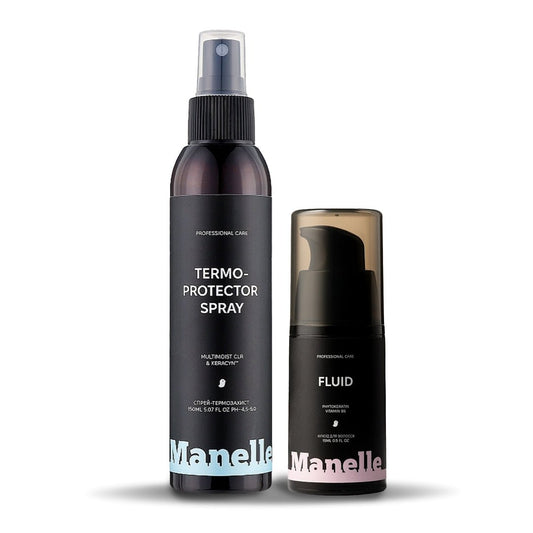
Sprays are the most popular format due to their ease of application and quick distribution. They have a liquid texture on a water or alcohol basis, which is instantly absorbed into the hair structure. Thermal protection for hair in spray format is suitable for all types, especially for thin and oily hair. Spray it on damp hair from a distance of 20-30 cm, evenly covering each strand.
Mists or fluids have a denser texture and a higher concentration of protective components - up to 20-25% of active ingredients. They are ideal for thick, curly or very damaged hair. Unlike sprays, mists leave a light layer on the surface, which additionally smoothes the cuticle and adds shine. Professional thermal hair protection in mist format often contains additional styling properties to control frizz.
The choice between formats depends on the type of hair. Thin hair responds better to light sprays, thick and porous hair needs denser sprays. Thermal protection for hair reviews confirm that a combination of both formats gives the best result: a spray for even distribution, a bridge on the ends for additional protection of the most vulnerable area.
Professional hair thermal protection: why salon formulas are more effective
Professional cosmetics are designed to withstand the extreme conditions of daily salon styling. Stylists work with different hair types for 8-10 hours a day, so they need products that guarantee protection without compromise.
Professional thermal protectors contain 20-30% active ingredients, while the mass market is limited to 5-10%. This explains the difference in price and effectiveness - one bottle lasts 4-6 months with daily use, providing guaranteed protection up to 230°C. Innovative technologies include microencapsulated proteins, which are released under the influence of high temperature exactly where it is needed. Professional thermal protectors for hair from brands such as Kerastase, Redken, Schwarzkopf Professional include anti-static complexes and UV filters.
The quality of raw materials and specialization of formulas are the key advantages of salon cosmetics. Professional thermal protectors are hypoallergenic, do not contain sulfates and parabens. The best thermal protector for hair often has specialization - for dyed hair with color protection, for curly hair with curl control, for thin hair with a thickening effect. Such precision allows you to solve a specific problem as effectively as possible.

Thermal protection for hair reviews: what to look for
User reviews are a valuable source of information, but they need to be interpreted correctly. Not all reviews are equally useful due to lack of context or incorrect use of the product.
When reading reviews, it’s important to understand the context of the application. What works on thick, curly hair may weigh down fine, straight hair. Look for reviews from users with your hair type. Professional heat protectant reviews often include technical details—what temperature it protects up to, how quickly it absorbs, and whether it leaves a greasy residue. These parameters are much more important than general phrases.
Pay attention to the period of use in the reviews. If a person has tested the thermal protection only once, their opinion is not very informative. The effect is cumulative - the more regularly you use it, the more noticeably the condition of your hair improves. Reliable thermal protection for hair reviews describe the experience of at least a month of use with details about the frequency of styling and temperature regimes. The critical factor is the price-quality ratio. The best thermal protection for hair in the "price-quality" category is often the middle segment of 300-600 UAH.
How to use thermal protection correctly: step-by-step instructions
Even the best heat protectant won't work without proper application technique. Most product disappointments are related to violating basic application rules.
Hair preparation
The effectiveness of thermal protection is 50% dependent on proper preparation. Always start with clean hair - thermal protection applied to dirty strands does not penetrate the structure and does not work. After washing, dry your hair with a towel until it is damp - thermal protection for hair is applied to damp, not wet hair. Excess water dilutes the formula and reduces the concentration of protective components by 40-50%.
Product distribution is critical for even protection. Divide hair into sections — at least 4, for thick hair — 6-8. Treat each section separately, spraying the heat protectant from a distance of 20-30 cm. Comb through with a comb for even distribution from roots (stepping back 3-5 cm) to ends. Professional heat protectant for hair should cover every hair.
Drying time and styling
Allow the heat protectant to dry completely before using hot tools—this is the most important step. Sprays dry in 2-3 minutes, bridges take 5-7 minutes. You can blow dry with a hairdryer on a warm setting to speed things up. Applying a flat iron to hair that has not dried creates a steam bath effect. Hair heat protectant reviews often mention this mistake as a cause for frustration.
When styling, adhere to optimal temperature conditions. Thin, dyed hair requires 150-170°C, thick natural hair can withstand 180-200°C. Do not hold the iron on one strand for longer than 3-5 seconds. The best heat protectant for hair protects effectively, but does not make styling completely safe at excessive temperatures.
The best thermal protection for hair: selection criteria
Determining the "best" heat protectant is a personal choice and depends on a variety of factors. Understanding the key criteria will help you find your perfect product.
By hair type
Fine hair needs lightweight formulas labeled "volume" or "lightweight." The best heat protectant for fine hair has a light spray consistency. Avoid creamy textures and formulas with oils — they take away volume. Ideal ingredients: hydrolyzed keratin, panthenol, rice proteins. Apply only to the length, avoiding the roots by 5-7 cm.
Thick, curly and porous hair requires intensive protection due to its larger surface area. It is suitable for denser bridges and creams with a high content of silicones and oils. Professional thermal protection for hair of this type contains smoothing components and moisture control. The combination of formats gives the optimal result: spray for the entire length, bridge for the ends.
By condition and problems
Color-treated hair is most vulnerable due to the damaged cuticle structure. Look for heat protectants labeled "color protection" — they contain UV filters and antioxidants. The best heat protectant for hair after coloring should include keratin complexes, amino acids, and ceramides. Some formulas contain heat-activated proteins that "seal" the cuticle scales under the influence of heat.
Damaged hair requires restorative formulas with a high concentration of proteins. Thermal protection for hair for severely damaged types should contain hydrolyzed keratin, silk proteins and ceramides. For maximum effect, combine thermal protection with regular restorative masks. Professional thermal protection for hair reviews confirm that even very damaged hair can recover in 2-3 months of comprehensive care.

7 fatal mistakes in using thermal protection
-
Root application - heat protection at the roots makes hair greasy and loses volume. Always stand 3-5 cm away from the scalp.
-
Using on wet hair - water turns into steam inside the hair under the influence of temperature, breaking it from the inside. Apply to damp, not wet hair.
-
Insufficient product - saving leads to uneven coverage and missed unprotected areas.
-
Use the iron immediately - the heat protectant needs 3-7 minutes to dry and form a protective film.
-
Skipping heat protection for your hair dryer - regular drying with hot air without protection damages your hair just as intensely.
-
Using a heat protectant as a hair care product is a styling product, not a replacement for a mask. Professional heat protectant for hair protects against heat, but does not restore without comprehensive care.
-
Ignoring the expiration date - after 12-18 months, the components degrade and lose their protective functions.
Temperature modes: adapt styling to your hair
Understanding temperature regimes is just as important as choosing the right heat protection. Even the best product has its limits.
Most professional formulas guarantee protection up to 220-230°C, but this does not mean using maximum temperatures every day. Fine, colored hair requires 150-170°C for ironing, 60-80°C for blow-drying. Thick natural hair can withstand 180-200°C with heat protection. Curly hair is especially sensitive - its porous structure absorbs heat faster, so reduce the temperature by 10-15°C.
Modern stylers have temperature control — use it wisely. Start with the minimum temperature and increase it only if necessary. Professional thermal protection for hair reviews confirm that the correct temperature regime is more important than the iron's break. If possible, give your hair "rest days" — do without hot appliances 2-3 times a week.
Combination with other means: creating a protection system
Thermal protection works best when used in conjunction with other care products. Understanding the correct sequence maximizes protection and improves results.
The correct sequence after washing: shampoo → conditioner → towel dry → heat protection → blow dry 80-90% → styling product → iron/curling iron → finishing oil for the ends. This system provides maximum protection at each stage. Professional heat protection for hair is often developed as part of a line for a synergistic effect.
If you use additional styling products (mousse, spray, cream), apply them after the heat protectant, but before styling. The exception is finishing products like shine spray or tip oil. Some lines produce multifunctional "2-in-1" products - heat protectant + styling. The best heat protectant for hair can include light fixation or frizz control without additional products.
Myths and reality about thermal protection
Myth 1: "Expensive irons don't damage hair, thermal protection is not needed"
Reality: Ceramic coating provides even temperature distribution, but does not reduce the exposure temperature itself. Even the most expensive iron operates at 180-230°C, which destroys keratin without protection. Thermal protection for hair is mandatory regardless of the class of the device.
Myth 2: "Thermal protection weighs down hair"
Reality: Modern professional heat protectants are lightweight and don't affect volume when used correctly. The key is to choose according to your hair type: a lightweight spray for fine hair, a thicker spray for thick hair.
Myth 3: "Natural oils replace thermal protection"
Reality: Most oils have a low smoke point of 150-180°C. When heated above this, they oxidize and become a source of damage themselves. Professional heat protectant for hair contains synthetic polymers that are stable up to 230°C.
Myth 4: "The more thermal protection, the better"
Reality: Excess does not enhance protection, but creates greasiness. The optimal amount is a thin, even layer that is completely absorbed.
Professional tricks from stylists
Experienced craftsmen know the secrets that turn ordinary thermal protection into the most effective tool.
The first trick is the "sandwich" technique: a thin layer of heat protectant on damp hair, blow-drying, another lighter layer before ironing. Double protection is important for very damaged hair. Professional heat protectant for hair has a light texture for layering without weighing it down. The main thing is to let each layer dry completely.
The second secret is the division into temperature zones. The most vulnerable areas (tips, face frame, temples) are treated with an additional portion and styled at a lower temperature. Stylists use different temperatures for different zones. The best thermal protection for hair allows you to flexibly adapt the protection to individual characteristics.
The third technique is to test the temperature before styling. Take a thin strand from the bottom layer, treat it with heat protection and iron it. If you smell burning or the strand becomes too dry, reduce the temperature by 10-20°C. Heat protection for hair reviews from professionals emphasize the importance of an individual approach.
Seasonal features of use
Hair needs change depending on the season. Adapting your heat protection to the seasonal features helps maximize the effect.
Summer requires enhanced protection from UV radiation, seawater, and chlorine. Choose heat protectants with SPF filters of at least 15-30. Ultraviolet destroys keratin just like high temperatures, and in combination the effect doubles. Professional heat protectant for hair of the summer series contains antioxidants and moisture control. In summer, give preference to light sprays.
Winter is a time of dry air and static electricity. Switch to thermal protection with additional moisturizing components - hyaluronic acid, glycerin, panthenol. Thermal protection for hair in winter formulas has antistatic properties. Give preference to rich textures - mists and creams. In winter, it is important not to go out with wet hair - water droplets freeze and break the structure.
Investing in the health of your hair
Heat protection for hair is an absolute necessity for anyone who uses hot tools. Scientific studies prove that temperatures above 150°C destroy the keratin structure, leading to brittleness and premature aging of hair. Properly selected professional heat protection minimizes thermal damage by 60-70% and allows you to enjoy beautiful styling without harm.
Choosing the best heat protectant for your hair depends on your hair type, the frequency of styling and temperature regimes. Read heat protectant for hair reviews from users with your type, pay attention to the composition, do not save on quality. Remember the correct application technique, adequate temperatures, drying time and a comprehensive approach to care. Investing in high-quality professional heat protectant pays off by preserving the health, beauty and longevity of your hair.