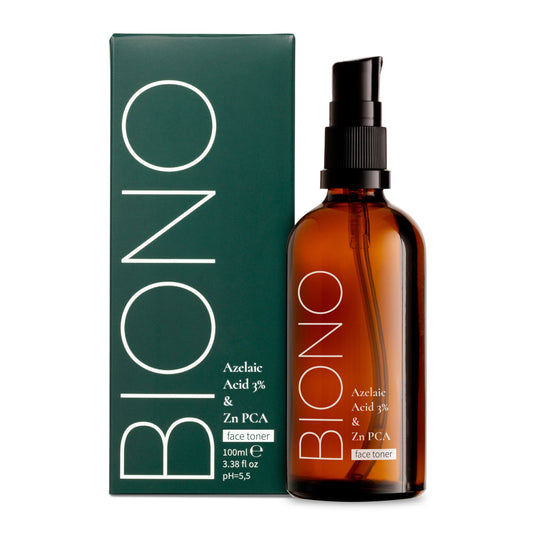
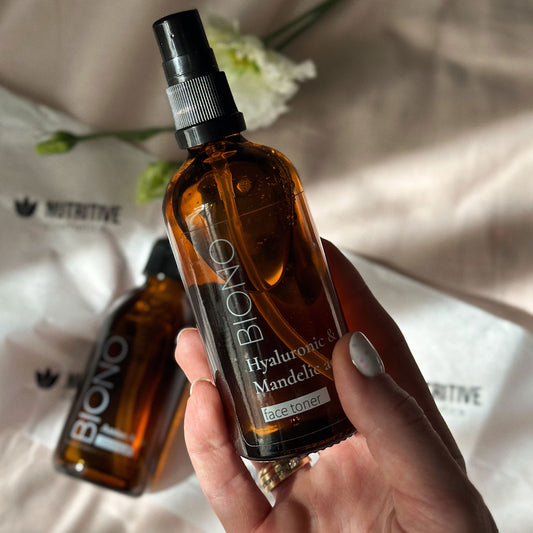
Renewing Face Toner: Glycolic, Mandelic, and Hyaluronic Acids
Skincare has long ceased to be limited to basic cleansing and moisturizing — today it is a well-thought-out system where each step has its own task. Among all products, it is the exfoliating facial toner that has become the link without which it is difficult to achieve an even tone, smoothness, and healthy appearance. It prepares the skin for subsequent stages, gently exfoliates, restores comfort, and helps active ingredients work more effectively.
Why exfoliating toner has become an essential step in skincare
The skin is constantly renewing itself: thousands of dead cells are shed from its surface every day. But with age, due to stress, poor sleep, UV radiation, or poor environmental conditions, this process slows down. As a result — dull complexion, uneven texture, clogged pores, fine wrinkles that become more noticeable. Ordinary washing does not cope with such a problem, as it acts only at the highest level of the epidermis and does not activate cell renewal.
This is where glycolic acid toner or another acidic toner comes into play – a product that gently stimulates regeneration without traumatizing the skin. It doesn't just care, but restarts natural processes: it dissolves the "glue" between dead cells, evens out the microrelief, and restores radiance. Regular use gives an effect that cannot be achieved with creams alone: the skin becomes denser, smoother to the touch, and decorative cosmetics apply flawlessly.
Another argument in favor of such a product is its versatility. It suits almost all skin types; you just need to choose the right concentration and frequency of application. For oily and combination skin, it's a salvation from blackheads and enlarged pores; for dry skin, it's a way to gently remove flakes and enhance hydration; for mature skin, it's an anti-aging booster that works every night.

Glycolic acid toner: the classic of chemical exfoliation
Glycolic acid is the most famous representative of AHA acids, derived from sugar cane. Its molecule is the smallest among all alpha-hydroxy acids, so it penetrates deeper into the skin and provides the most pronounced results. Glycolic acid toner is a product that dermatologists and beauty editors have long loved for its ability to literally "rejuvenate" the skin in a few weeks of regular use.
The principle of action is simple: glycolic acid breaks down the bonds between old cells of the stratum corneum, accelerates their removal, and initiates the synthesis of new ones. In parallel, it stimulates collagen production, so the skin becomes not only smoother but also denser. Glycolic acid toner is especially recommended for problems such as: dull complexion, post-acne, hyperpigmentation, fine wrinkles, uneven texture, and a tendency to clogged pores.
What to remember when using:
- start with a low concentration (5–7%) and apply 2–3 times a week, gradually increasing the frequency;
- always apply SPF 30+ in the morning — acids increase photosensitivity;
- do not combine with retinol, vitamin C, or scrubs in one application to avoid irritation;
- after application, wait 1–2 minutes and then apply serum or cream;
- stop using 5–7 days before cosmetic procedures (cleansing, peels, laser).
Mandelic acid toner: a gentle alternative for sensitive skin
If glycolic acid seems too active, mandelic acid toner comes to the rescue. Mandelic acid also belongs to the AHA family, but it has a significantly larger molecule, so it penetrates the skin more slowly and gently. This makes it an ideal choice for sensitive, reactive skin, as well as for those who are just starting their acquaintance with acid-based skincare.
A special advantage of mandelic acid is its antibacterial properties. It effectively combats breakouts, regulates sebaceous glands, and does not provoke a "purging" of the skin with all hidden imperfections coming to the surface, as often happens with more aggressive formulas. Due to its delicacy, mandelic acid is well-tolerated in summer (although SPF is still mandatory), and it is also allowed for use with rosacea and couperose — of course, after consulting with a cosmetologist.
Mandelic acid toner is especially beneficial for conditions such as adult acne, post-inflammatory pigmentation, sensitive skin with an impaired barrier, and the first signs of photoaging. Regular use results in an even tone, softness, and a feeling of cleanliness without tightness. Many people notice results within two weeks: the skin becomes calmer, breakouts decrease, and the tone evens out.
Facial toner with hyaluronic acid: deep hydration without compromise
Unlike AHA acids, hyaluronic acid does not exfoliate — it moisturizes. It is a natural molecule found in our skin that can hold water up to a thousand times its weight. A facial toner with hyaluronic acid is a non-irritating product that suits literally everyone: from teenagers to mature women, from dry to oily skin.
The value of such a toner lies in its ability to restore moisture to the skin immediately after washing, when it needs it most. You've probably noticed how your skin starts to feel "tight" after contact with water – this means that the barrier is partially compromised, and moisture is actively evaporating. Hyaluronic acid toner solves this problem in a matter of seconds, restoring comfort and preparing the face for the application of serums and creams. Without this step, moisturizing products work much less effectively.
Key benefits of such a product:
- rapid elimination of tightness and dryness;
- smoothing of fine dehydration wrinkles (they disappear when the skin receives enough moisture);
- enhancement of the effects of cream and serum applied afterwards;
- safe compatibility with all other active ingredients – acids, retinol, niacinamide, peptides;
- no restrictions based on season or skin type.

How to choose your exfoliating facial toner
The choice depends not only on the skin type, but also on current tasks and experience with active ingredients. If the skin is normal and you want a light daily renewal, a toner with mandelic acid or a combined product with a low concentration of AHA will be an optimal start. It is low-risk, provides a gradual effect, and is well-tolerated. For skin that is accustomed to acids and needs serious results, a glycolic acid toner with a concentration of 7–10% will be suitable.
Dehydrated skin is a special case. Here, the priority is a facial toner with hyaluronic acid, and it can be used together with an acid toner: first apply the acid toner with a cotton pad, then the moisturizing one with your hands. This scheme works as a double blow: exfoliation plus immediate moisture restoration. Oily and problematic skin responds best to alternating different acids: for example, mandelic twice a week, glycolic twice, and hyaluronic on the remaining days to maintain balance.
It is also worth focusing on the ingredients: a high-quality exfoliating facial toner contains not only an active acid, but also soothing components – aloe, panthenol, green tea extract, centella asiatica, niacinamide. They compensate for possible irritation and make the formula more comfortable. Avoid products with alcohol among the top five ingredients – it dries out the skin and negates the effect of acids.
Mistakes that negate the effect of acid care
The first and most common mistake is using acid toners too often. The desire to get results faster leads to the opposite: the skin reacts with peeling, redness, a burning sensation, and sometimes even real dermatitis. Acids are not cosmetics where "more = better." An initial frequency of 2–3 times a week gives the skin time to adapt; after a month, you can switch to daily use if there is no reaction.
The second mistake is neglecting sun protection. Any AHA acid makes the skin vulnerable to ultraviolet light, and without SPF, instead of renewal, you can get pigmentation and photoaging. This rule applies all year round, not just in summer. The third mistake is mixing acids with incompatible active ingredients: retinol, high concentrations of vitamin C, and benzoyl peroxide, when applied simultaneously, create an excessive burden on the skin.
Among other typical problems, it is worth mentioning:
- applying toner to wet skin (the effectiveness of acids decreases because water dilutes the formula);
- using after aggressive cleansing with soap — the skin is already irritated, acids will only exacerbate the reaction;
- ignoring moisturizing after the acid step — the skin needs barrier restoration;
- use on damaged skin (wounds, active inflammation, burns);
- expecting an instant effect — real changes are visible after 3–4 weeks of regular use.
How to properly incorporate toner into your daily routine
The sequence of care is no less important than the products themselves. An exfoliating facial toner always goes in the second step — after cleansing and before serum. It can be applied in two ways: with a cotton pad and gentle movements along the massage lines, or simply with your palms, lightly patting into the skin. The first option provides additional mechanical cleansing, the second is more economical and suitable for sensitive skin.
Morning application of acid toner is possible, but requires strict SPF on top. Most cosmetologists recommend leaving acids for the evening so that the skin can calmly renew itself during sleep. And in the morning, use a facial toner with hyaluronic acid — it provides instant hydration, prepares the skin for makeup, and does not limit your choice of sunscreen. This "morning-evening" scheme allows you to get the most out of each product without overloading the skin.
A smart combination of toners with different active ingredients significantly increases the effect. For example, after an acid toner, serums with peptides, niacinamide, and centella work wonderfully. And after a hyaluronic toner — any creams, oils, and masks. After a month of regular use, the first changes are noticeable: an even tone, smoothness, reduced pores. After three months — a real transformation that others will notice.
Summary: exfoliating facial toner as the foundation of healthy skin
A properly chosen toner is that rare case when a simple product provides visible and stable results. Glycolic acid works for those who need intensive renewal; mandelic acid — for delicate care and sensitive skin; hyaluronic acid — for deep hydration without limitations. Often, the best solution is to have several such toners in your arsenal and alternate them depending on your skin condition and season.
The most important thing is consistency and respect for your own skin. Don't chase a quick effect at the cost of irritation. Instead, consistent, thoughtful care with a properly selected toner, sun protection, and hydration guarantees what you truly want: healthy, radiant skin that looks naturally beautiful at any age.